
YouTube automation, honestly explained (and how to do it right)
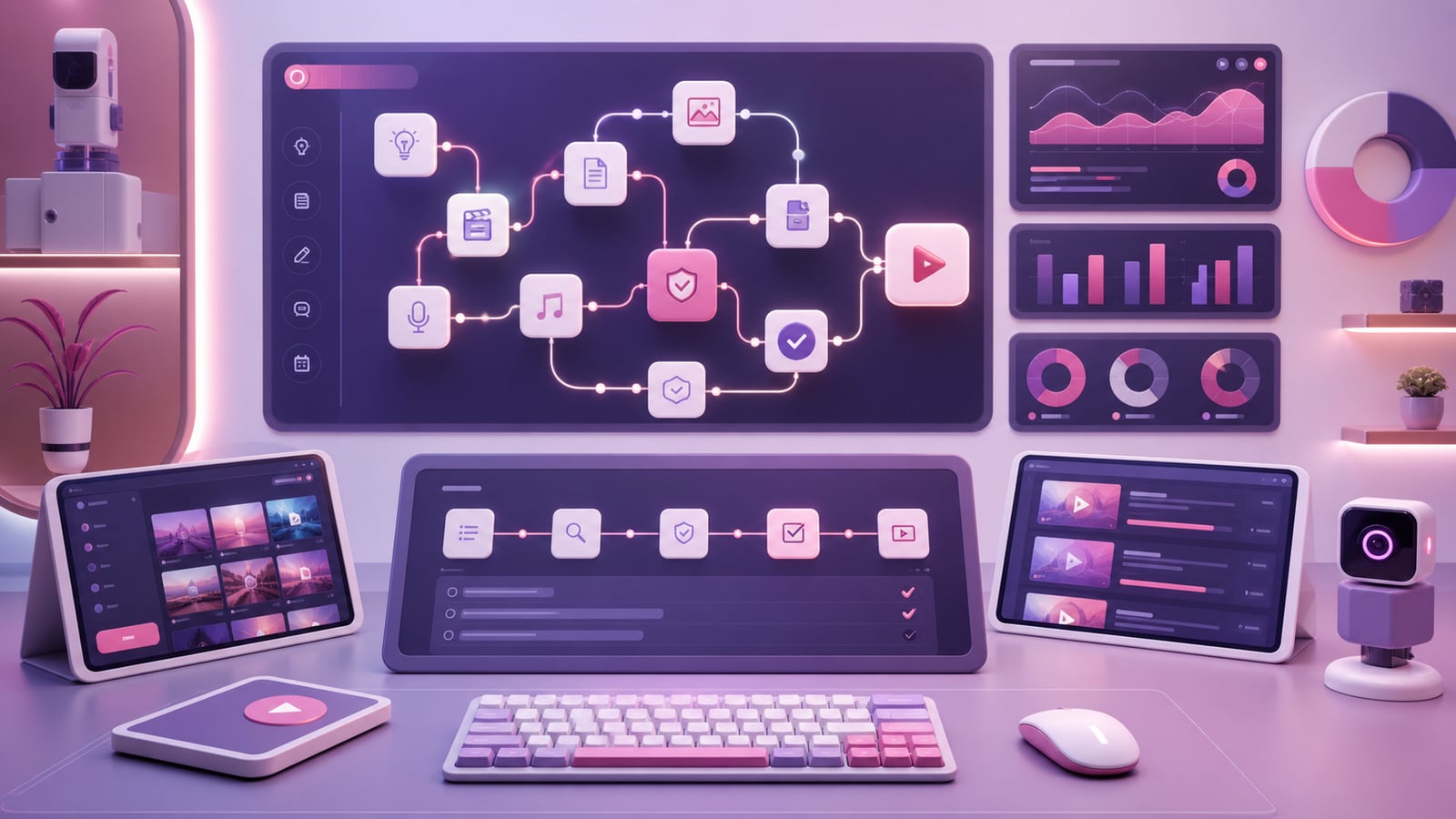
"YouTube automation" is one of the most over-sold phrases in online business. It gets marketed as a passive-income button — buy the course, outsource everything, collect checks while you sleep — which is exactly the version that does not work. But strip away the hype and the underlying idea is genuinely real and very doable: running faceless channels on a systemized, mostly-automated production pipeline so a person spends minutes per video instead of hours, and can operate several channels at once.
The confusion is in the word "automation." It does not mean a bot makes and uploads videos with no human involved. It means the repetitive, mechanical parts of production — scripting drafts, voiceover, footage selection, captions, rendering — are handled by tools and templates, freeing the human to do the parts that actually decide success: choosing the niche, writing the hook, and holding the quality bar.
This is the honest version: what automation really is, the myths that get people burned, the platform rules you cannot automate around, and a sustainable way to build a real automated channel that survives algorithm changes.
What it actually means
Automation is leverage applied to production, not a replacement for judgment. Concretely, it means each stage of the pipeline is templated or tool-assisted so it takes minutes instead of hours.
- Scripting: an AI drafts a hook-first script against your locked structure, and you sharpen it.
- Voiceover: a consistent AI voice narrates in seconds, no microphone or retakes.
- Footage: AI matches relevant b-roll to each line instead of you scrubbing stock sites.
- Captions: frame-synced word-by-word captions are generated automatically from the voiceover.
- Rendering and scheduling: exports queue locally and post on a calendar.
Notice what is still human in that list: the niche, the hook taste, and the quality check. Automation handles the busywork; you handle the judgment. That division is the entire game.
The myths to ignore
Most people who fail at YouTube automation were sold one of these three myths.
- "It is fully passive." It is a business, not a vending machine — it needs ongoing decisions about niches, hooks, and quality.
- "No skill needed." Taste in hooks, packaging, and niche selection is the part that wins, and it cannot be outsourced to a tool.
- "Just post low-effort spam at volume." Platforms actively demote reused, mass-produced, and inauthentic content — volume without quality gets buried or removed.
Automate the production. Never automate the taste. The day you outsource the judgment is the day the channel dies.
The rules you cannot automate around
This is the part the course-sellers skip, and it is the part that gets channels demonetized. YouTube's monetization policies single out content that is mass-produced, repetitive, or made with little original input. The platform has steadily tightened its stance on low-effort, templated uploads designed purely to game the system.
Do this: use automation to remove the manual labor while keeping genuine original input — your own scripts, your own angle, your own quality bar — on every video. Not that: spin the same script across dozens of near-identical uploads, scrape and re-upload other people's content, or batch out spam with no human improvement. The first is a legitimate production system. The second is exactly what the policies are written to catch, and it ends in demonetization.
The sustainable way to do it
A durable automated channel follows a simple, repeatable loop — and keeps a human at the points that matter.
- 1Pick a niche you can genuinely stand producing in for a year, not just a high-CPM one you will quit.
- 2Build a repeatable format: fixed structure, voice, and caption style you can fill in fast.
- 3Automate the production stages — scripting drafts, voice, footage, captions, render.
- 4Keep a human on the hook, the thumbnail, and the quality bar for every single video.
- 5Read the retention data after each batch and feed what worked back into the format.
- 6Repeat consistently, and only clone the system to a new channel once the first one works.
Originality and consistency are what survive algorithm changes. Automate the busywork relentlessly; protect the judgment fiercely.
How much can you realistically expect?
Set expectations honestly. A new automated channel typically takes months of consistent posting before it clears monetization thresholds — on YouTube, generally 1,000 subscribers plus 4,000 watch-hours, or roughly 10 million Shorts views in 90 days. Early income usually comes from affiliates long before ad revenue switches on. The creators who profit are the ones who treated month one to six as building the machine, not collecting from it. "Passive income by next month" is the marketing; "a real business in six to twelve months" is the reality.
The toolchain
The practical version of automation is collapsing the whole pipeline into one place instead of stitching together five subscriptions. Write or generate the script, create the voiceover, let AI match footage and captions, and render locally — that is the automation, minus the per-tool fees and the upload waits. The fewer tools you juggle, the fewer places your process can break, and the more of your minutes go to the judgment that actually matters.
Common mistakes
- Buying the "passive income" promise and quitting when month one is not profitable.
- Outsourcing the hook and niche decisions — the exact things that cannot be automated.
- Mass-producing near-duplicate uploads and getting demonetized under reused-content policies.
- Re-uploading or scraping others' content instead of producing original work.
- Chasing a high-CPM niche you have no interest in and burning out before it compounds.
- Cloning the system to five channels before the first one has proven it works.
Frequently asked questions
Is YouTube automation against the rules?
Running faceless channels with AI-assisted production is fine. What violates policy is mass-produced, repetitive, or reused content with no original input. The line is original effort: automate the labor, not the originality.
Can I really run a channel without showing my face or recording my voice?
Yes — that is the whole faceless model. AI voiceover replaces the microphone and matched b-roll replaces on-camera footage. What you bring is the script angle, the hook, and the quality judgment.
How is this different from spammy 'content farms'?
A content farm scrapes or duplicates with no human input and gets demoted or removed. A legitimate automated channel uses tools to speed up original production while a human keeps every video genuinely worth watching. Same tools, opposite intent — and the platform can tell the difference.
Build a real automated channel
Clipmesh gives you the entire faceless pipeline in one desktop app — script generation, AI voiceover, auto-matched footage, frame-perfect captions, and local rendering — so you can automate the production without the per-tool subscriptions or the upload waits. Free to start and rendered locally, it is the toolchain for building a sustainable automated channel without buying into the hype.