Thumbnails & titles that get clicks (packaging for faceless videos)
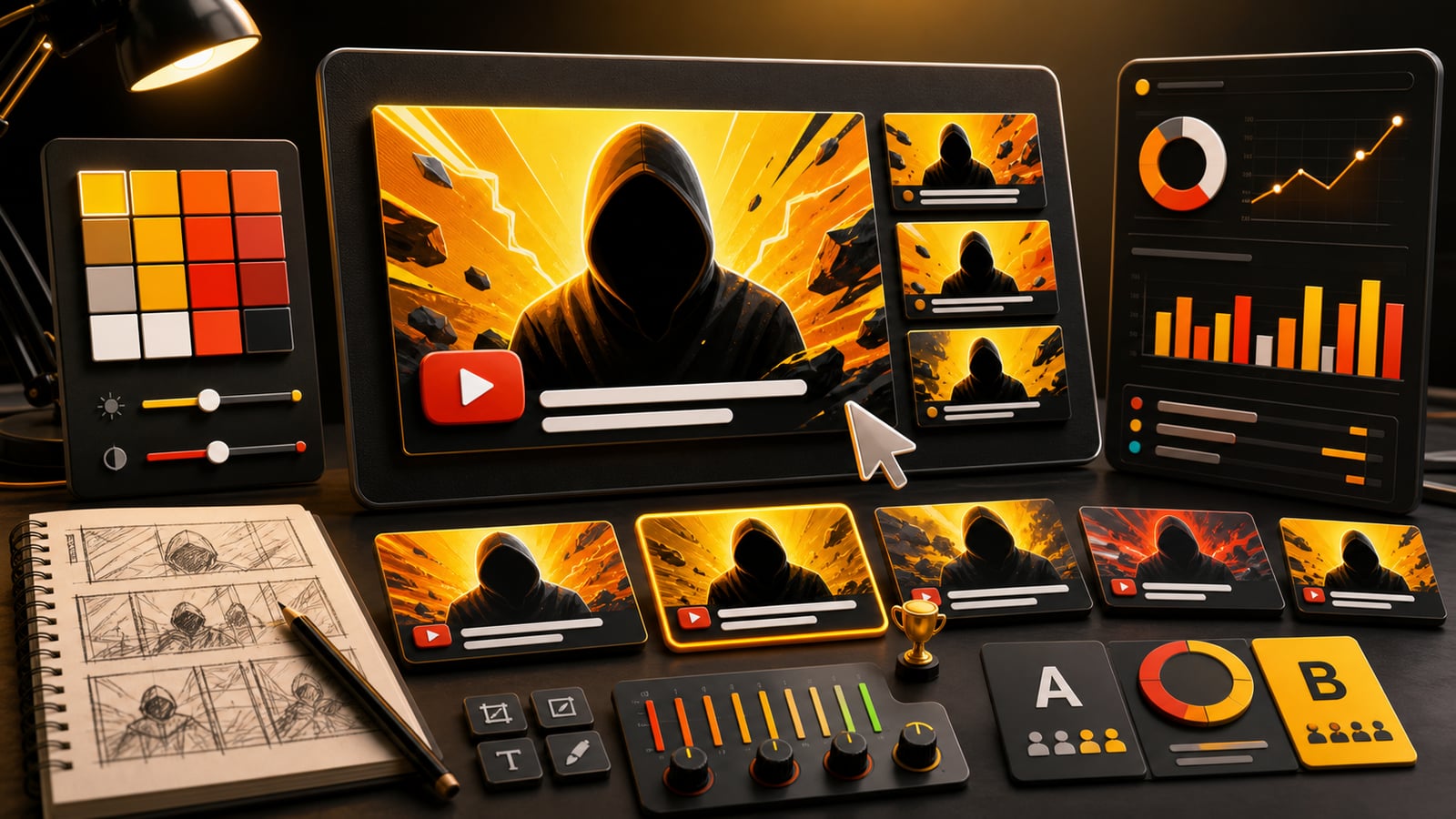
On YouTube, the best video in the world gets zero views if nobody clicks it. Your title and thumbnail — what creators call 'packaging' — are the actual product on the homepage. The video is what people get after they click; the packaging is what makes them click. And yet most creators pour hours into the video and slap together the packaging in five minutes.
For faceless channels, packaging is even more important, because you don't have a recognizable face or personality to pull the click. Your title and thumbnail have to do all the work of selling the click on their own. The upside: faceless packaging is a craft you can learn and systematize, with patterns that work reliably across niches.
This guide covers the title formulas that win clicks, the thumbnail rules that survive a tiny screen, why the two have to work together, how Shorts packaging differs, and how to test your way to a high click-through rate.
Understand click-through rate first
Click-through rate (CTR) is the percentage of people who click your video after it's shown to them. It's the gatekeeper metric: high CTR tells YouTube your packaging is compelling, so it shows the video to more people; low CTR caps your reach no matter how good the content is.
- A typical 'healthy' CTR for many niches sits somewhere around 4–10%, but it varies widely by niche and audience.
- CTR and retention work together — a clickbait title that wins the click but loses viewers immediately tanks the video. You need both.
- Judge your CTR against your own channel's average and against where the video was shown, not a universal benchmark.
Title formulas that work
Strong titles almost always lean on one of a few proven psychological levers. Pick the one that fits the video and lead with it.
- Curiosity gap: "The mistake everyone makes with sleep" — opens a loop the viewer needs to close.
- Specific number: "3 habits that quietly made me rich" — concrete and scannable; odd numbers and specifics outperform round ones.
- Bold claim: "You've been doing this wrong your whole life" — pattern-interrupt that demands a click.
- Stakes / consequence: "Why your channel isn't growing (and the fix)" — names a problem the viewer has and promises the solution.
- Contrarian angle: "Stop saving money. Do this instead." — challenges a default belief.
Title craft details that matter
- Front-load the most compelling words — titles get truncated, and the first few words do the heavy lifting.
- Keep it tight; aim for roughly 50–60 characters so nothing important gets cut off in the feed.
- Use power words sparingly (secret, mistake, nobody, finally) — overused, they stop working.
- Don't repeat the thumbnail text — the two should combine, not echo.
Thumbnail rules
A thumbnail has to win attention at the size of a postage stamp on a phone screen, often surrounded by competing thumbnails. Clarity beats cleverness every time.
- One clear focal point — readable and understandable at a tiny size; clutter loses.
- High contrast and bold colors — your thumbnail has to pop against a white or dark feed.
- Minimal text: 3–4 words maximum, in a big, legible font. The thumbnail isn't where you explain — it's where you intrigue.
- A consistent style across videos so your channel is instantly recognizable in a list of recommendations.
- Curiosity, not a spoiler — show enough to make them need to click, never the whole answer.
Title and thumbnail must work together
The most common packaging mistake is making the title and thumbnail say the same thing. That wastes half your real estate. They should combine into one idea, each carrying part of the message: the thumbnail grabs the eye and raises a question; the title closes — or deepens — the curiosity loop.
Example: a thumbnail showing a melting ice cube with the word 'WRONG' paired with the title '5 fridge mistakes costing you money.' The image creates intrigue; the title pays it off and adds stakes. Neither alone is as strong as the pair.
Spend as long on the title and thumbnail as you do on the first draft of the script. It's the part most people actually see — and the only part that decides whether the rest gets seen at all.
Shorts and TikTok packaging is different
On short-form, there's no separate thumbnail in the feed — your 'packaging' is the first frame and the on-screen text in the first second. The scroll decision happens instantly, so treat your opening frame the way you'd treat a thumbnail.
- Open on a visually striking or curiosity-provoking frame, not a slow fade-in.
- Put bold, large on-screen text in the first second that states the hook or promise.
- The caption/title still matters for context and search — front-load the keyword.
Test your packaging systematically
Packaging is too important to guess at. The creators with the highest CTRs treat it as an experiment, not a one-shot.
- 1Before publishing, sketch 2–3 title options and 2–3 thumbnail concepts for each video.
- 2Pick the strongest pair, but keep the alternatives.
- 3After a video has run, check its CTR; if it's below your channel average, swap the title or thumbnail and watch whether CTR recovers.
- 4Keep a running file of your highest-CTR packaging patterns and reuse what wins.
Common packaging mistakes
- Title and thumbnail repeating the same words — wastes half your packaging.
- Tiny or low-contrast thumbnail text that's unreadable at feed size.
- Pure clickbait that the video doesn't deliver — wins the click, destroys retention, gets the video buried.
- Cramming too much into the thumbnail — multiple focal points read as visual noise.
- Treating packaging as an afterthought — spending hours on the edit and seconds on the title.
- Never testing — publishing one title/thumbnail and never revisiting underperformers.
Frequently asked questions
What's a good CTR for a faceless channel?
It varies by niche, but many channels land somewhere in the 4–10% range. More useful than a universal number is your own channel's trend — is a given video's CTR above or below your average? That tells you whether the packaging is pulling its weight.
Can I change a thumbnail after publishing?
Yes, and you should for underperformers. Swapping the thumbnail or title on a low-CTR video and watching whether reach recovers is one of the fastest ways to learn what packaging works for your audience.
Do faceless channels need a person in the thumbnail?
No. Faceless channels win with bold objects, expressive graphics, big text, and high contrast instead of a face. A clear focal point and an open curiosity loop matter far more than whether a human is in the frame.
Package and produce in one place with Clipmesh
Great packaging gets the click; great content keeps the viewer. Clipmesh handles the content side of that equation — script, AI voiceover, auto-matched footage, frame-synced captions, and fast local rendering — so the video reliably delivers on whatever your title and thumbnail promised. Spend the time you save on sharper packaging, and let the tool make sure every click lands on a video worth watching.