How to write viral short-form scripts (hooks, structure & retention)
A short-form video lives or dies in its first two seconds. You can have perfect footage and a great voice, but if the hook does not land, nobody sees the rest. The platforms make this brutal on purpose: the algorithm decides within the opening moments whether to keep showing your video, and it judges almost entirely on whether early viewers stay or swipe.
The good news is that hooks and retention follow patterns you can learn and reuse. Viral scripts are not magic — they are engineered. Below is the full framework: how to write a scroll-stopping hook, how to structure the body so every line earns the next, how to write for the ear instead of the eye, and the mistakes that quietly tank otherwise-good videos.
Most short-form narration runs around 150 words per minute, which means a 30-second clip is only about 75 words. Every one of those words is fighting for the viewer's attention. Treat the script as the highest-leverage thing you produce — it is cheaper to rewrite a hook than to re-shoot anything.
The two-second hook
Your opening line has exactly one job: stop the scroll. Do not introduce yourself, do not set context, do not say 'In this video.' Start mid-action, in the middle of the most interesting moment. The four most reliable hook types are the bold claim, the curiosity gap, the direct question, and the specific number.
- Bold claim: "You've been brushing your teeth wrong your whole life."
- Curiosity gap: "Nobody talks about this 5-minute fix."
- Direct question: "Why are you always tired by 2pm?"
- Number / listicle: "3 money habits that quietly made me rich."
- Contrarian take: "Stop drinking water first thing in the morning. Here's why."
- High-stakes stakes: "This one mistake cost me $40,000."
Pair the verbal hook with a visual hook
On muted feeds, your first frame is half the hook. The opening visual should be motion-rich and slightly disorienting — a question on screen, a surprising image, a fast zoom. A flat static intro frame undoes a great opening line, because the viewer never gets to the audio.
Front-load the payoff promise
Right after the hook, tell viewers what they will get and why it is worth staying. "By the end of this you'll know exactly how to fix it" sets a contract. The viewer stays because you promised a reward and have not delivered it yet — that open loop is what holds them.
The retention spine
After the hook, every line should earn the next one. Use a simple spine: hook, promise, proof beats, payoff. Stack short, concrete proof beats that keep delivering small rewards, and never bury the value behind throat-clearing. The viewer is constantly asking 'why am I still here?' — answer it every few seconds.
- 1Hook — stop the scroll in the first two seconds.
- 2Promise — tell them precisely what they will get.
- 3Proof — three quick, concrete beats that deliver on the promise.
- 4Payoff — one clear, repeatable takeaway they can act on.
- 5Loop or CTA — end on a line that invites a re-watch, comment, or follow.
Cut dead air and re-hook the middle
The biggest retention drop in most short-form happens at the natural lull right after the hook's energy fades — usually around the one-third mark. Fight it with a mid-clip re-hook: a new question, a twist, or 'but here's the part nobody mentions.' On longer content, re-hook every 20 to 30 seconds.
Write for the ear, not the eye
Short-form scripts are spoken, so write the way people actually talk. One idea per sentence. Cut adjectives. Use contractions. Read it out loud — if you stumble, rewrite it. The best scripts feel like a smart friend explaining something fast, not an essay being narrated. Punchy fragments beat grammatically perfect run-ons every time.
- Do: "Most people quit here. Big mistake."
- Not: "It is at this particular juncture that the majority of individuals tend to discontinue their efforts, which is regrettable."
- Do: short sentences, concrete nouns, active verbs.
- Not: hedging, qualifiers, and 'sort of / kind of / basically.'
A repeatable script template
Once a structure works, template it so each new video is a fill-in-the-blank instead of a blank page. A battle-tested 30-second template looks like this:
- 1Line 1 (hook): a bold claim or number that contradicts what the viewer expects.
- 2Line 2 (promise): the specific thing they will learn by the end.
- 3Lines 3 to 6 (proof): three to four concrete beats, one idea each.
- 4Line 7 (payoff): the single takeaway, phrased so it is easy to remember and repeat.
- 5Line 8 (loop): a closing line that rewards a re-watch or invites a comment.
Let AI draft, then you edit
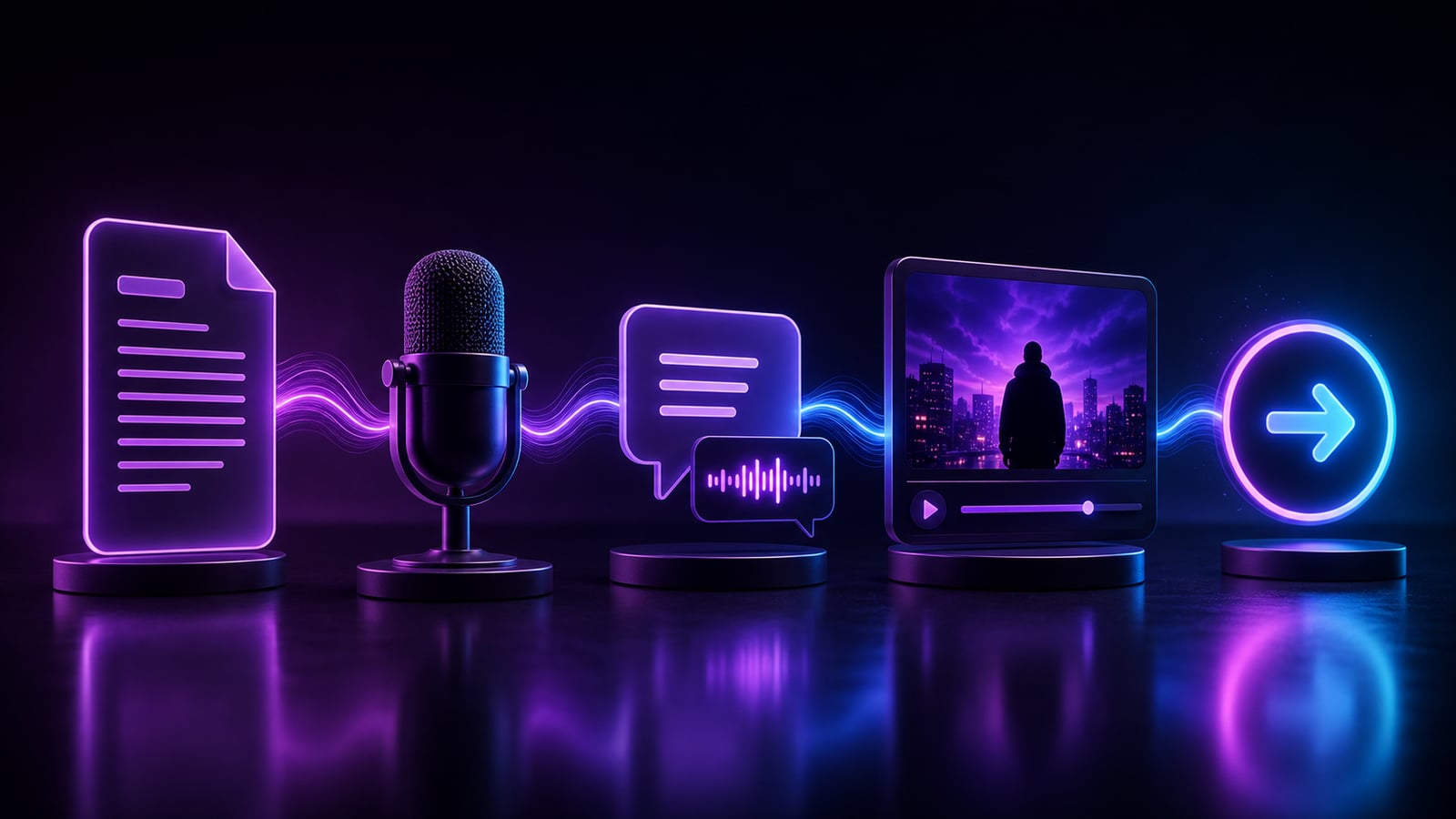
The fastest workflow is to have an AI writer draft a hook-first script for your topic, then you cut it down and sharpen the hook. AI is great at structure and speed; you add the taste, the specificity, and the personality. In Clipmesh you can generate the script and send it straight to a voiceover in one flow, so the gap between 'idea' and 'narrated draft' is seconds, not an afternoon.
Great short-form isn't written — it's edited. Draft fast, then cut everything that isn't the hook or the payoff.
Common scriptwriting mistakes
- Slow intros: opening with 'Hey guys, in today's video' instead of the most interesting line.
- Burying the payoff: making viewers wait too long for the value you promised.
- Too many ideas: cramming three topics into one clip dilutes all of them.
- Writing like an essay: long sentences and formal words that nobody says out loud.
- No re-hook: letting the energy flatline at the midpoint where retention dies.
- Weak ending: trailing off instead of landing a memorable, repeatable takeaway.
Frequently asked questions
How long should a short-form script be?
For a 30-second clip, aim for roughly 75 words; for 60 seconds, around 150. Spoken narration averages about 150 words per minute, so write to the clock, not the page. Shorter is usually safer — a tight 25-second video that holds attention beats a padded 50-second one that loses people at the midpoint.
What makes a hook go viral?
A viral hook creates an open loop the viewer needs to close — a question they want answered, a claim they want to verify, or a number that demands explanation. It works on muted feeds when the opening frame visually reinforces the curiosity. The single biggest lever is specificity: '$40,000' beats 'a lot of money' every time.
Should every video use the same structure?
Use the same proven spine (hook, promise, proof, payoff) but vary the hook type and the topic. Consistency in structure makes you faster and your channel recognizable; variety in hooks keeps the feed from feeling repetitive. Template the bones, change the flesh.
Turn the script into a finished video
Once your script is sharp, the rest is automation. In Clipmesh, generate the script, send it to an AI voiceover, auto-sync word-by-word captions, let the AI director match b-roll to each line, and render locally — all in one app on your own machine. The script is where your judgment lives; the tool handles everything downstream.