The best AI voice for each faceless niche (a practical guide)
The voice is the single most underrated lever in faceless video. Creators obsess over hooks and footage, then narrate everything with whatever default voice came up first - and wonder why retention sags halfway through. The truth is that the same script can feel completely different read by a calm narrator versus a high-energy one, and that fit is one of the strongest predictors of whether viewers stay or swipe.
The right AI voice is not the most expensive one or the most advanced model. It is the one whose tone, pacing, and accent match what your niche's audience expects to hear. A sleep-story channel needs a voice that lowers heart rates; a money channel needs one that projects authority and momentum. Get the match right and the voice does half the retention work for you. Get it wrong and even a perfect script underperforms.
This guide breaks down which voice characteristics fit each major faceless niche, why pacing matters as much as the voice itself, how accent and language change performance, and the one rule that beats all the others: pick a signature voice per channel and never change it.
Match tone to niche
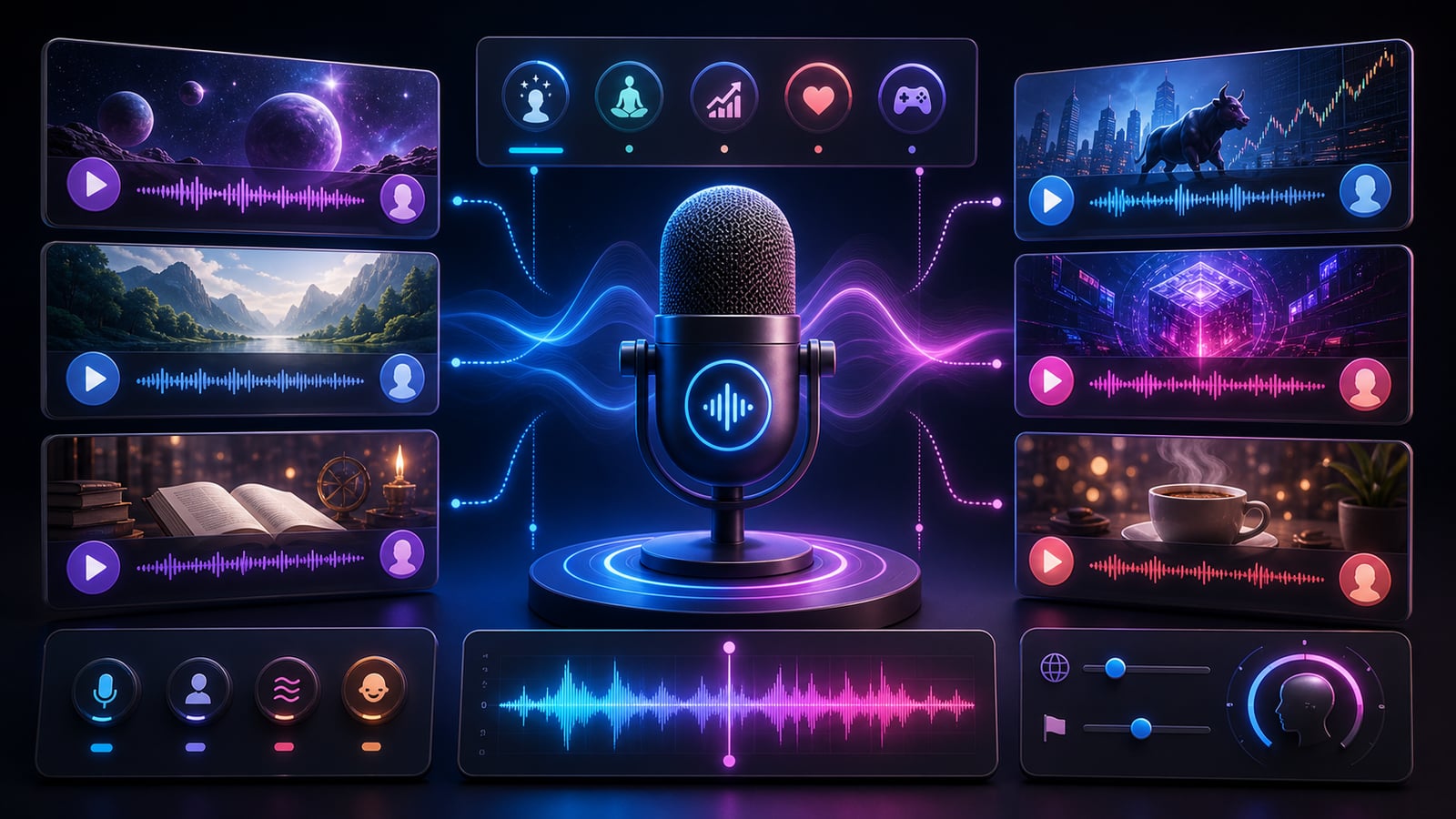
Start with the feeling your niche needs to create, then pick a voice that produces it. Here is how the major faceless niches map to voice characteristics, with the kind of voice to reach for in each:
- Sleep and relaxation - slow, soft, low-energy delivery with long pauses; a warm, breathy narrator that never spikes in volume
- Money and business - confident, brisk, authoritative; a clear adult voice that sounds like it knows what it is talking about
- History and documentary - warm, measured, with narrator gravitas; the steady, slightly formal tone of a documentary voiceover
- Horror and scary stories - quiet, deliberate, a little tense; restraint and slow pacing build more dread than a dramatic read
- Motivation - punchy, intense, rising energy; a voice that can build and land hard on the payoff line
- Psychology and facts - clear, curious, conversational; a friendly voice that sounds like a smart person explaining something
- Tech and AI news - crisp, neutral, fast; an articulate voice that handles jargon cleanly without sounding robotic
- Kids and storytelling - bright, animated, expressive; warmth and playfulness over polish
Test by listening, not by spec sheet
Do not pick a voice from a name or a model number. Generate the same 20-second hook with three or four candidates and listen back-to-back on the device your audience uses - usually a phone speaker. The voice that makes you want to keep listening is the one. Trust your ear over the marketing copy.
Pacing matters as much as the voice
Even a perfectly chosen voice falls flat at the wrong speed. Pacing is the difference between calming and boring, between energetic and frantic. The two ends of the spectrum need opposite treatment:
- Slow content (sleep, meditation, ambient) wants generous breathing room - long pauses, unhurried delivery, no rush to the next line
- Fast content (Shorts, motivation, money tips) wants a quick, punchy cadence with no dead air, every line earning the next
Good text-to-speech engines respect punctuation, which means you control pacing from the script itself. Write in short lines. Use commas for small beats and periods for full stops. Add an ellipsis where you want a longer pause. The rhythm of your writing becomes the rhythm of the read, so punctuate deliberately.
Accent and language
Accent signals trust and belonging. Pick an accent your target audience hears as native or authoritative for the topic - a documentary channel aimed at a British audience plays differently with a British narrator than an American one. There is no universally best accent; there is only the right accent for who you are talking to.
Language matters even more. A native-language voiceover dramatically outperforms subtitles laid over a foreign-language read, because viewers connect with sound, not just text. With 30-plus languages available out of the box, the same script can launch parallel channels in multiple markets - one production, several audiences - without re-recording a human voice for each.
Cloud versus local voices
You have two families of AI voices, and the right call depends on your stage and volume:
- Cloud voices (OpenAI, ElevenLabs) tend to be the most expressive and nuanced, billed per use or via credits - ideal when you want maximum quality on a flagship channel
- Local engines (Supertonic, Chatterbox) run free and offline on your own machine - ideal for batch production, validating niches, and keeping costs at zero while you scale
The best workflow is not to choose one forever. Use local voices to test niches and produce at volume for free, and reach for a premium cloud voice on the channel where expressiveness pays off. Pick per project, not once for all time.
Keep one signature voice per channel
This is the rule that overrides all the others. Once a voice works for a channel, lock it in and never change it. A consistent narrator becomes part of the channel's identity - viewers recognize it within a second, and that familiarity builds trust and pulls return views. Switching voices mid-channel quietly erodes that recognition and confuses an audience that came back specifically for that sound.
Do this, not that
A few clear contrasts separate creators who use voice as a weapon from those who treat it as an afterthought:
- Do match the voice's energy to the niche's feeling. Do not narrate sleep content with a money-channel voice.
- Do control pacing through punctuation. Do not let a flat monotone run end to end.
- Do narrate in your audience's language. Do not slap subtitles over a foreign-language read.
- Do lock one signature voice per channel. Do not change voices chasing novelty.
- Do test candidates on a phone speaker. Do not pick a voice from its name alone.
Pick the voice that fits the feeling, nail the pacing, then never change it. The voice is your channel's signature - consistency is what makes it recognizable.
Common mistakes
Voice errors quietly cost retention, and they are easy to fix once you see them:
- Reading every niche with the same default voice instead of matching tone to topic
- Ignoring pacing - the right voice at the wrong speed still bores viewers
- Walls of text with no punctuation, leaving the engine no cues for natural pauses
- Switching voices mid-channel and breaking the identity viewers came back for
- Subtitling foreign content instead of generating a native-language voiceover
Frequently asked questions
Is a more expensive voice always better?
No. Fit beats fidelity. A free local voice that matches your niche's tone and pacing will out-retain a premium voice that feels wrong for the content. Spend on quality only where the niche actually rewards extra expressiveness.
How do I make an AI voice sound less robotic?
Write for the ear, not the page: short lines, one idea per sentence, deliberate punctuation for pauses and emphasis. Good engines follow your punctuation, so the natural rhythm comes from how you write the script as much as from the voice you pick.
Should every video on my channel use the same voice?
Yes. A single signature voice per channel builds instant recognition and trust. Reserve different voices for different channels, not for different videos within one channel.
Find your signature voice in Clipmesh
Clipmesh supports five TTS providers across local and cloud, so you can preview voices side by side, generate the same hook in several candidates, and pick your channel's signature in minutes. Local engines keep batch production free; cloud voices are there when you want maximum expressiveness - and once you have chosen, every video on the channel inherits the same voice automatically.