How to batch-produce a week of videos in one sitting

Consistency is the single biggest predictor of faceless-channel growth, and the most reliable way to stay consistent is to stop making videos one at a time. Batching — producing a full week or month of content in one focused session — is how creators who post daily actually do it without living inside their editor. The secret is not working harder; it is organizing the work so the same task happens in bulk.
The enemy of output is context-switching. Every time you jump from writing a script to picking a voice to hunting for footage, your brain pays a hidden reset tax — research on task-switching consistently shows it bleeds time and focus. Batching eliminates those switches by grouping identical work together: all the scripting, then all the voicing, then all the editing. You stay in one mode, get faster as you go, and a ten-video week collapses into a single afternoon.
This guide lays out the exact batching workflow, the prep that makes it fast, and the mistakes that quietly break a batch session.
Why batching works
Three mechanics make batching outperform one-at-a-time production.
- No context-switching: doing one task ten times in a row keeps you in flow and removes the reset cost between modes.
- Warm-up compounds: the third script is faster than the first because you are already in the rhythm of the format.
- Setup amortizes: opening the tool, loading the voice, and setting the caption style happen once for ten videos, not ten times.
The result is not just speed — it is sustainability. A creator who batches a week in one sitting has six days off from production while still posting daily, which is the only way most people keep a cadence going for months.
Prep before you batch
A batch session is only fast if you do not have to make decisions mid-flow. Lock these before you start so the session is pure execution, not deliberation.
- 1Confirm your format: length, structure, voice, and caption style for this channel.
- 2Pull 10 to 15 topic ideas from your backlog so you never face a blank page.
- 3Have your hook bank open — the openings that have already worked for you.
- 4Make sure your tool, voice model, and footage library are ready and offline-capable.
The batching workflow
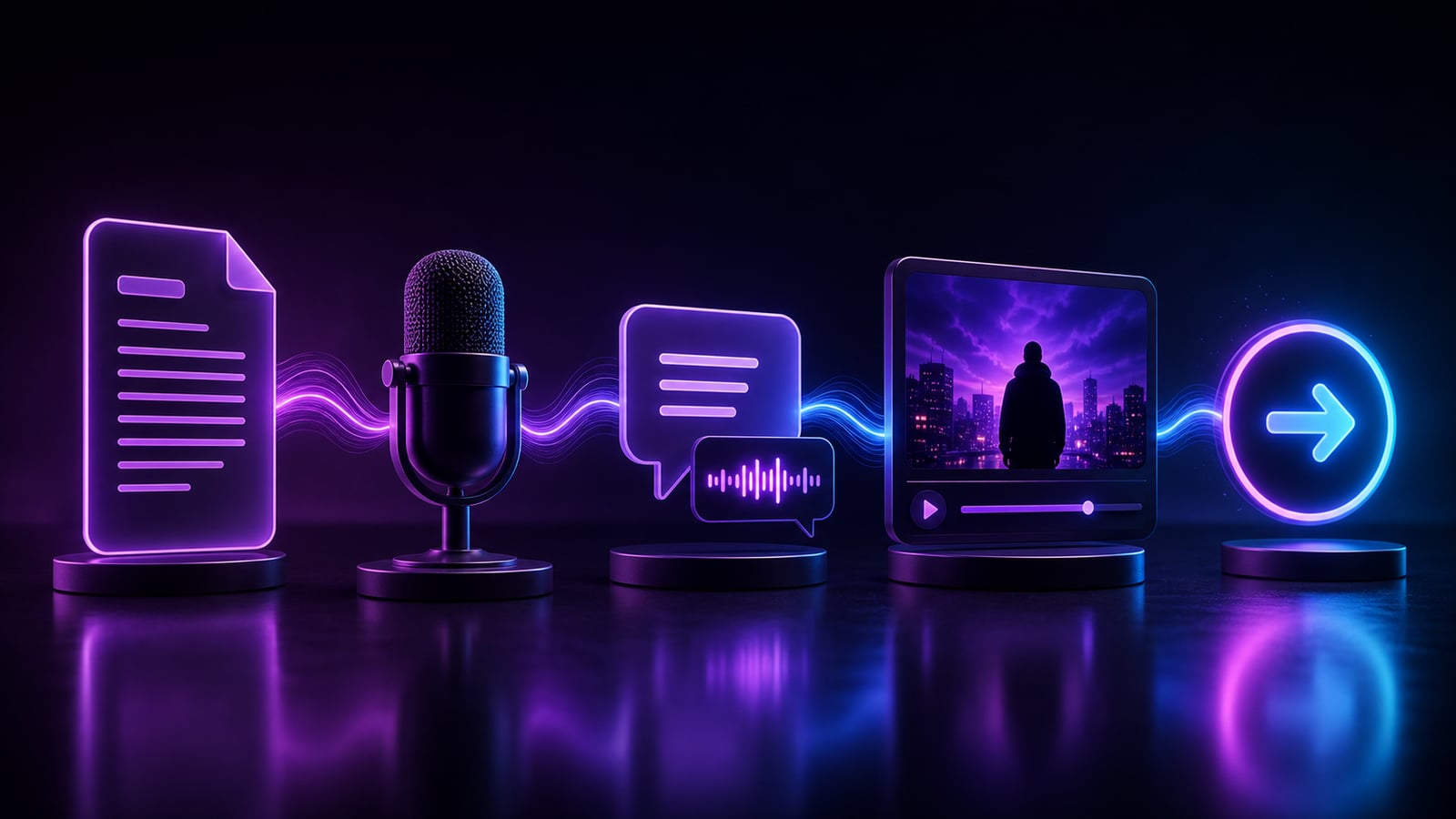
Run the session in distinct stages, finishing each one across all videos before moving to the next. Resist the urge to take a single video all the way to done — that reintroduces the exact context-switching batching exists to kill.
- 1Brainstorm 10 hooks for your niche in one go, drawing from your hook bank.
- 2Write or generate all 10 scripts back-to-back, against your locked structure.
- 3Generate all 10 voiceovers with the same signature voice for channel consistency.
- 4Let AI match footage and frame-synced captions for each video in turn.
- 5Quick-review each timeline — tighten hooks, swap any weak b-roll — without re-editing from scratch.
- 6Queue all 10 to render locally, then schedule them across the week.
Time-box each stage
Give each stage a hard limit so perfectionism cannot stall the batch. Ten hooks in 20 minutes, ten scripts in an hour, voiceovers in 15 minutes, edits and review in an hour or two. The clock keeps you moving and forces "good and done" over "perfect and unpublished."
Keep a swipe file
Save your best-performing hooks, structures, and b-roll patterns in one place. A growing swipe file makes every batch faster because you are remixing what already works instead of starting cold. Over a few months it becomes the most valuable document you own — your channel's playbook, written down. After every batch, add the best line and the best structure from that round so the file keeps compounding.
Render while you sleep
Rendering is the one stage that does not need you present, so it should never block your session. Local rendering lets you queue all ten exports and walk away — no cloud minutes ticking, no upload-then-wait round trips, no per-render fees scaling with your output. You finish the creative work in the afternoon and wake up to a week of finished videos ready to post. At volume, this is also what keeps batching affordable: rendering more videos does not grow your bill.
Do not make videos daily. Make them weekly, in bulk, and post daily.
Scale the batch as you grow
Once a weekly batch feels routine, stretch it. Many creators move to monthly batches — 20 to 30 videos in a long session or two — which buys even more buffer against busy weeks and reduces the number of times you have to set up at all. The same staged workflow scales; you are just running more items through each stage. A month of buffer is what makes a channel resilient to real life.
Common mistakes
- Taking one video all the way to done before starting the next — reintroducing the context-switch tax.
- Skipping prep, then making format and topic decisions mid-session and stalling.
- Switching voices between videos in a batch and breaking channel consistency.
- Over-polishing a single video instead of time-boxing and moving on.
- Using a cloud renderer that bills per minute, so a big batch becomes a real expense.
- Forgetting to feed the swipe file, so every batch starts as cold as the last.
Frequently asked questions
How many videos should I batch at once?
Start with one week of content — typically 5 to 10 videos — so the session stays focused and finishable. Once the rhythm is automatic, scale to two-week or monthly batches for more buffer.
Won't batched videos all feel the same?
They should share a consistent format and voice — that is the brand. Variety comes from the topics and hooks, not from reinventing the structure each time. Consistency is a feature, not a bug.
What if I get a great new idea mid-batch?
Write it in your backlog and keep going. Chasing a new idea mid-session breaks your flow and your time-box; the idea will still be there for the next batch.
Batch a week without the busywork
Clipmesh is built for batching: generate scripts, produce voiceovers in your signature voice, auto-match footage and frame-perfect captions, and queue every export to render locally on your own GPU — no cloud minutes, no upload waits, no watermark. Set your format once, run the stages, and walk away with a week of finished videos ready to post.